Well Gathered
Wholesome weekly menus for the whole household.
Healthy eating is better together. Well Gathered builds your family's weekly menu, tailored for the food each individual enjoys while also making sure it is nutritious — one menu, one shop, one table. No guilt, no stress, no one left out.

How it Works
Tell us about your table
We send you a form, you tell us who's eating, what they love, any little ones, any fussy eaters, any dietary needs. Well Gathered builds a menu that is built around your household.Vegetarian and meat eaters? No problem, we structure meals around a base that everyone enjoys and then add in extras at the end!Everything you need - even a structured Sunday Prep InstructionsWe send you a personalised, nutritious menu which caters for various diets and is built around meals your family already enjoy. We also send you a shopping list so you know exactly what is needed for the week - no waste, no fuss.If you like to batch cook - we also include a guide for a weekend prep session to help make weekdays more manageable.Finally we share some nutritional tips and tricks so that you feel more confident picking products that are best for you and your loved ones.
Why Well Gathered?
We know how difficult it can be to put a meal together that everyone will eat. Not to mention trying to figure out if everyone is getting a healthy and balanced meal that meets their nutritional needs.We believe the most nourishing thing you can do isn't find the perfect macro ratio. It's sit down with the people you love and actually eat together. Research confirms that loneliness is as damaging to health as smoking.We want to understand your household eating preferences, offer some suggestions on how to make them more nutritionally complete and introduce some new recipes that we think you will love.Well Gathered is built for real households. Mixed diets. Toddlers. Fussy eaters. Busy weeks. The odd Friday night where nobody wants to cook. We handle all of it — so you can focus on the part that actually matters - connecting with the ones you love.
Good food. Good company.
Browse our blogs to find out more

Get in touch
Send us an email to find out more or get started today.

Work with us
Are you a nutritionist, dietician or wellness professional? We'd love to hear from you.

More Plants, Less Fuss: Why Your Gut, Your Energy, and Your Wallet All Want the Same Thing
Here's a stat worth sitting with: UK adults are recommended around 30g of fibre a day. Most of us eat 18-20g. Kids often get even less.That gap isn't about willpower. It's about default recipes. Most meals are built meat-first, with a vegetable or two squeezed in as a side thought. Flip that order, vegetables and pulses as the base, some beef or chicken added on top, and the fibre gap starts closing without anyone trying particularly hard.The upside shows up in a few places at once:Your gut. Fibre and plant diversity feed the microbiome, which is increasingly linked to everything from digestion to immunity to mood.Your energy. Whole grains, beans, and vegetables release energy steadily, instead of the spike-and-crash of heavily processed, low-fibre food.The planet. Plant-rich meals generally have a smaller footprint than meat-heavy ones, even without going fully vegetarian.Your pocket. Beans and lentils are some of the cheapest protein on the shelf, and bulking a meal out with them stretches the meat you do buy further.The part people don't expect: done well, you barely notice. A bolognese built on lentils and mushrooms with some beef stirred through still tastes like bolognese. A curry that's mostly chickpeas and vegetables, with chicken added for whoever wants it, still tastes like the curry everyone already loves. Blitz the sauce well, cook the veg and pulses properly, and see if the meat-loving sceptics in your house even clock the difference.This isn't about cutting anything out. It's about what the meal is built on before anything else gets added.Most meal plans are built for one person. Well Gathered is built for your household. Tell us what everyone likes, and we build weeks around a plant-rich base with meat or fish layered in for whoever wants it, so you get the fibre, the flavour, and the family favourites, without anyone cooking twice.Curious what a plant-rich week actually looks like on your table? Click the link below to find out more.
Cracking the Code to Better Nutrition
There's so much information out there on what you should and shouldn't eat, it can all get pretty overwhelming. On top of that, supermarkets are packed with products built for convenience and taste, with little thought given to nutrition. So marketing teams fill the gap with a bold "healthy" or "low sugar" on the front instead.To help you cut through it, here are three simple rules.1) No darlin', I'm sweet enoughIgnore the "per portion" numbers on the front. Brands love a small portion size, it makes the sugar figure look tiny and reassuring. Flip it over and find sugar per 100g instead. If that number's sitting around 40g, that's roughly 10 teaspoons of sugar per 100g, basically 40% sugar, whatever the portion size says. Doesn't matter how small the packet is, you're still filling up on something that's nearly half sugar. Which, for the sake of your energy levels later as much as anything else, probably isn't the win the packaging is selling you.Rough rule of thumb: under 5g sugar per 100g (about 1 teaspoon) is genuinely low. Anything nudging toward 20g and up (5 teaspoons or more) is a "sometimes" food, not a "whenever" one. Salt works the same way, under 0.3g per 100g is low, barely a pinch, and cartoons on the front tell you nothing either way.2) Need more time to process?You'll hear about whole foods, processed foods, and ultra-processed foods. Processing just means something's been done to the food, freezing, heating, cooling, even chopping, so it's not automatically a bad thing. In fact, most of what we eat is processed in some way. The issue is ultra-processed food, where a long list of ingredients you wouldn't find in nature (or in your own kitchen) has been added in.A simple example: corn on the cob is a whole food, frozen sweetcorn is processed, and cornflakes are ultra-processed.The easiest way to spot it: read the label, and if there are words on there you've never seen in a recipe book, it's probably worth a second look.3) Consistency beats perfectionFood is a pleasure and something to genuinely enjoy. Fad diets come and go, and the more restrictive they are, the harder they are to stick with. We believe the best thing you can do is build sustainable habits. That's why we start by finding out what you already love, and think of ways to make it more nourishing. We want your household to have a healthy relationship with food, not one that feels restrictive, but one that leaves you feeling more energetic, satisfied, and able to enjoy your treats guilt-free.Curious what that looks like for your household? Click below to find out more.
Bring Back the Family Meal
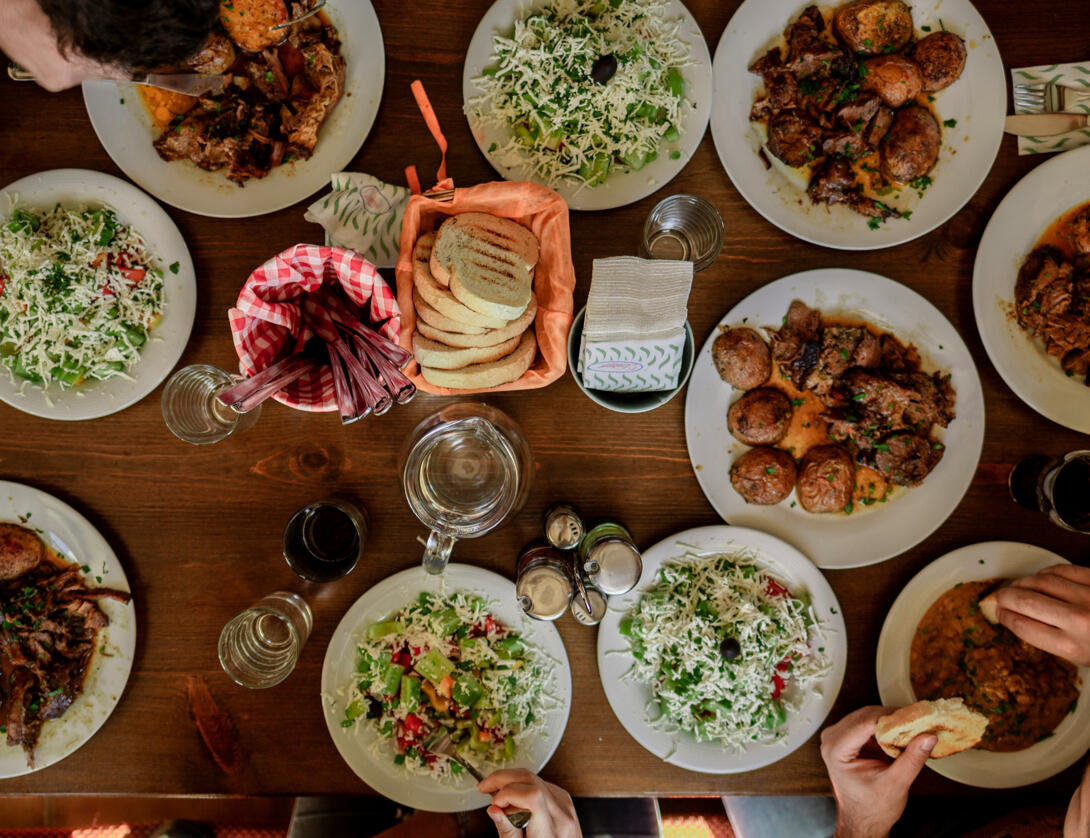
Maybe one of you doesn't like meat. Someone else wants meat with everything.Different dietary preferences or nutritional goals often leads to people eating meals separately.But what if gathering at the table matters just as much as the menu? Research shows that eating together, even for fifteen scrappy minutes, does something for a family that no individually optimised meal can. Loneliness and disconnection are genuinely bad for health, in ways that stack up over time. A shared meal is good for us and a great habit to build as a couple or family.A few things that help:Build from a shared base. A plant-rich foundation with meat or fish added separately for whoever wants it means one pot, one table, no separate cooking.
Let babies join in, even messily. Age-appropriate portions of the same meal beat a pouch eaten alone in a highchair. Music on, hands in the food, mess included.
Drop the idea of a perfect dinner. A relaxed, imperfect meal together beats a nutritionally flawless one eaten in shifts.Most meal plans are built for one person. Well Gathered is built for your household. You tell us what everyone likes and dislikes, the fussy eater, the vegetarian, the one who won't touch anything green, and we work out clever ways to get everyone eating the same meal together, with as little extra cooking as possible. On top of that, we know that not everyone has the same work schedule. Someone opting out one day, or needs a packed lunch the next- we have got you covered. Find out more below.
Convenience of a meal kit, without the downsides
Meal kits solved a real problem: nobody wants to plan dinner from scratch every night. If you've tried one for more than a few weeks though, you've probably hit the same wall.There's a lot of rice, pasta, and filler carbs doing the heavy lifting. Drop down to fewer delivery days to save money and the per-meal cost climbs anyway. You've got no real say over where the ingredients come from, and the boxes pile up, packaging within packaging, for food you could've bought loose at the supermarket. Finally, most kits are built around one person's preferences, so it doesn't always work for a household.We think there's a better version of the same idea. All the convenience of a weekly plan, none of the box.Real supermarket ingredients at supermarket prices
Nutritious melas We build plans that are well balanced nutritionally and align with NHS guidance
One plan for the whole household, mixed diets and toddler portions included, not one-size-fits-all
No subscription box to cancel, no packaging piling up
Full control over sourcing, since you're ingredients are built into your weekly shop, you can swap in your favourite brands and products.Right now, we send you a clear list split into fresh and pantry items, so you know exactly what to grab and what you've already got in,Ready to try a plan that brings all of the convenience of a meal kit, with much more flexibility?